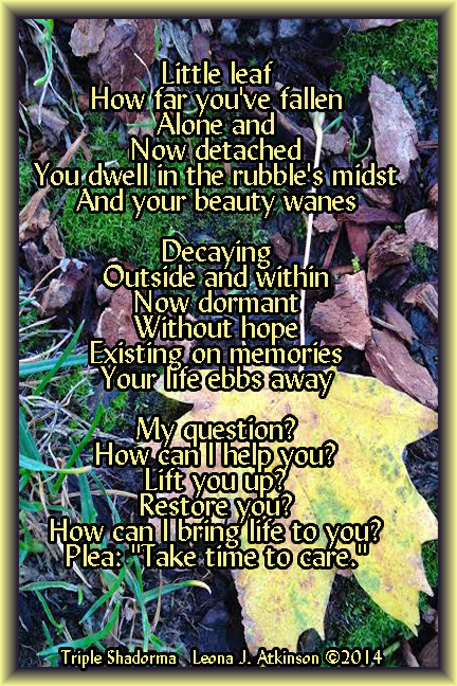
I hope you enjoyed my first Triple Shadorma poem that was inspired by encountering this little leaf. I dedicate this poem to all the elderly people who are now in nursing homes or care centers living out their lives perhaps in loneliness, hopelessness, or feeling no one cares. This little leaf I saw today reminded me of them.
This leaf reminded me to stop in the middle of my busy life to think of ways to reach out and care for others.
I am glad I am a part of a ministry (Expressions of Miriam Ministries) that volunteers to go into these homes to visit with the people there and perhaps uplift and encourage them in some way by bringing the joy of life and the love of God into their waning lives.
This poem was inspired by my daughter Laura’s viewing of a moth in flight. (She actually wrote a poem that she gave me permission to edit, which I did and transformed it into this Tanka.) The moth she watched was flying free and graceful until he got too close to the light. Then, zap! He was gone….sad. She and I saw kind of a lesson in this, in that we should be careful of getting too close to things that attract us because they might not be good for us and we could suffer for it!
Some good information found on why moths are attracted to light: “Moths frequently appear to circle artificial lights, although the reason for this behavior remains unknown. One hypothesis to explain this behavior is that moths use a technique of celestial navigation called transverse orientation. By maintaining a constant angular relationship to a bright celestial light, such as the moon, they can fly in a straight line. Celestial objects are so far away, that even after travelling great distances, the change in angle between the moth and the light source is negligible; further, the moon will always be in the upper part of the visual field, or on the horizon. When a moth encounters a much closer artificial light and uses it for navigation, the angle changes noticeably after only a short distance, in addition to being often below the horizon. The moth instinctively attempts to correct by turning toward the light, causing airborne moths to come plummeting downward, and resulting in a spiral flight path that gets closer and closer to the light source.” “Why Are Moths Attracted to Flame?”. npr.org. August 18, 2007.
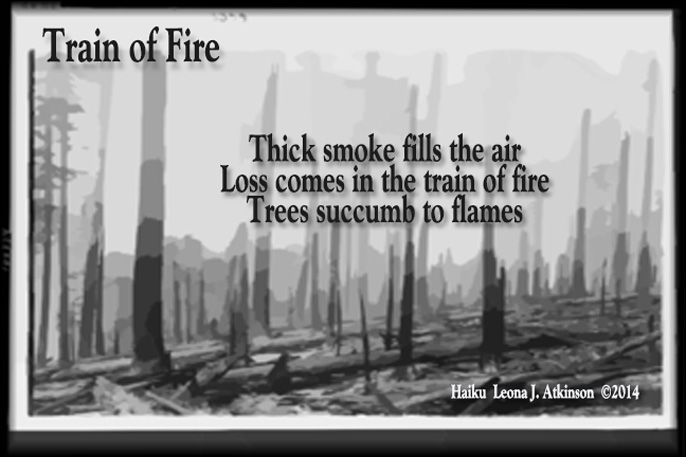
According to Dictionary.com one definition of “train” is: the series of results or circumstances following or proceeding from an event, action, etc.; aftermath In my Haiku “A Train of Fire” I seek to raise awareness of the yearly increase of damages to our forests in the Pacific Northwest because of Forest fires. Not only are many acres of trees damaged or lost, wildlife suffer loss of homes and people often do also. Firefighters risk their lives and health while fighting these fires so often uncontainable because of the wind and dry conditions. As Smoky the Bear says “only you can prevent Forest fires”. Please consider and do your part to protect our natural resources.




 Leonas Lines--Poetry Plus