Posted in January 2019, Scripture, Tanka

Tarry Time

Leaves in Fall

New Year days in flight,

Flying away like fall leaves.

What is your vision?

Are your dreams anchored down,

To withstand the winds of time?

Tanka

And the LORD answered me, and said, Write the vision, and make it plain upon tables, that he may run that readeth it. For the vision is yet for an appointed time, but at the end it shall speak, and not lie: though it tarry, wait for it; because it will surely come, it will not tarry Habakkuk 2:2-3

Posted in October 2014, Tanka

A Fatal Attraction

Tanka poem about a moth attracted to the light
Original Poetry by Leona J. Atkinson ©2014
(graphics from clker.com)

This poem was inspired by my daughter Laura’s viewing of a moth in flight. (She actually wrote a poem that she gave me permission to edit, which I did and transformed it into this Tanka.) The moth she watched was flying free and graceful until he got too close to the light. Then, zap! He was gone….sad.  She and I saw kind of a lesson in this, in that we should be careful of getting too close to things that attract us because they might not be good for us and we could suffer for it!

Some good information found on why moths are attracted to light:
“Moths frequently appear to circle artificial lights, although the reason for this behavior remains unknown. One hypothesis to explain this behavior is that moths use a technique of celestial navigation called transverse orientation. By maintaining a constant angular relationship to a bright celestial light, such as the moon, they can fly in a straight line. Celestial objects are so far away, that even after travelling great distances, the change in angle between the moth and the light source is negligible; further, the moon will always be in the upper part of the visual field, or on the horizon. When a moth encounters a much closer artificial light and uses it for navigation, the angle changes noticeably after only a short distance, in addition to being often below the horizon. The moth instinctively attempts to correct by turning toward the light, causing airborne moths to come plummeting downward, and resulting in a spiral flight path that gets closer and closer to the light source.“Why Are Moths Attracted to Flame?”. npr.org. August 18, 2007.

Posted in Rhyme, September 2013

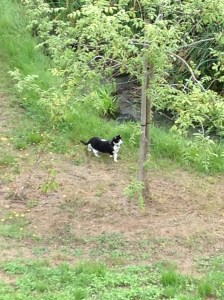
Aha! The Intruder

Cat in the MeadowI hear chirping in the meadow,
I run quickly to see!
Have the little songbirds returned?
Oh really, can it be?
Am I once again to be blessed,
by the sweet, cheerful sounds,
of the little creatures singing,
among the reeds that grace the grounds?

Ah, yes, I see a flutter, a movement on a reed!
But, now the chirping sounds alarming,
And causes me to wonder indeed!
The song is not one so charming,
but one full of alarm and fright.
A clear sound of warning,
a chirp commanding quick flight!

Then, out of the corner of my eye,
I see a movement in the grass.
What is out there in the meadow?
Something that seems to trespass…

Aha! Tis the neighbor’s cat,
Seeking to find the sound that she too heard.
She left her perch whereupon she sat,
to discover the chirping bird!

Now, this story has a happy ending,
of which I am glad indeed!
For the little bird took flight,
before the cat reached it’s reed!

Rhyme
Leona J. Atkinson  09-05-13